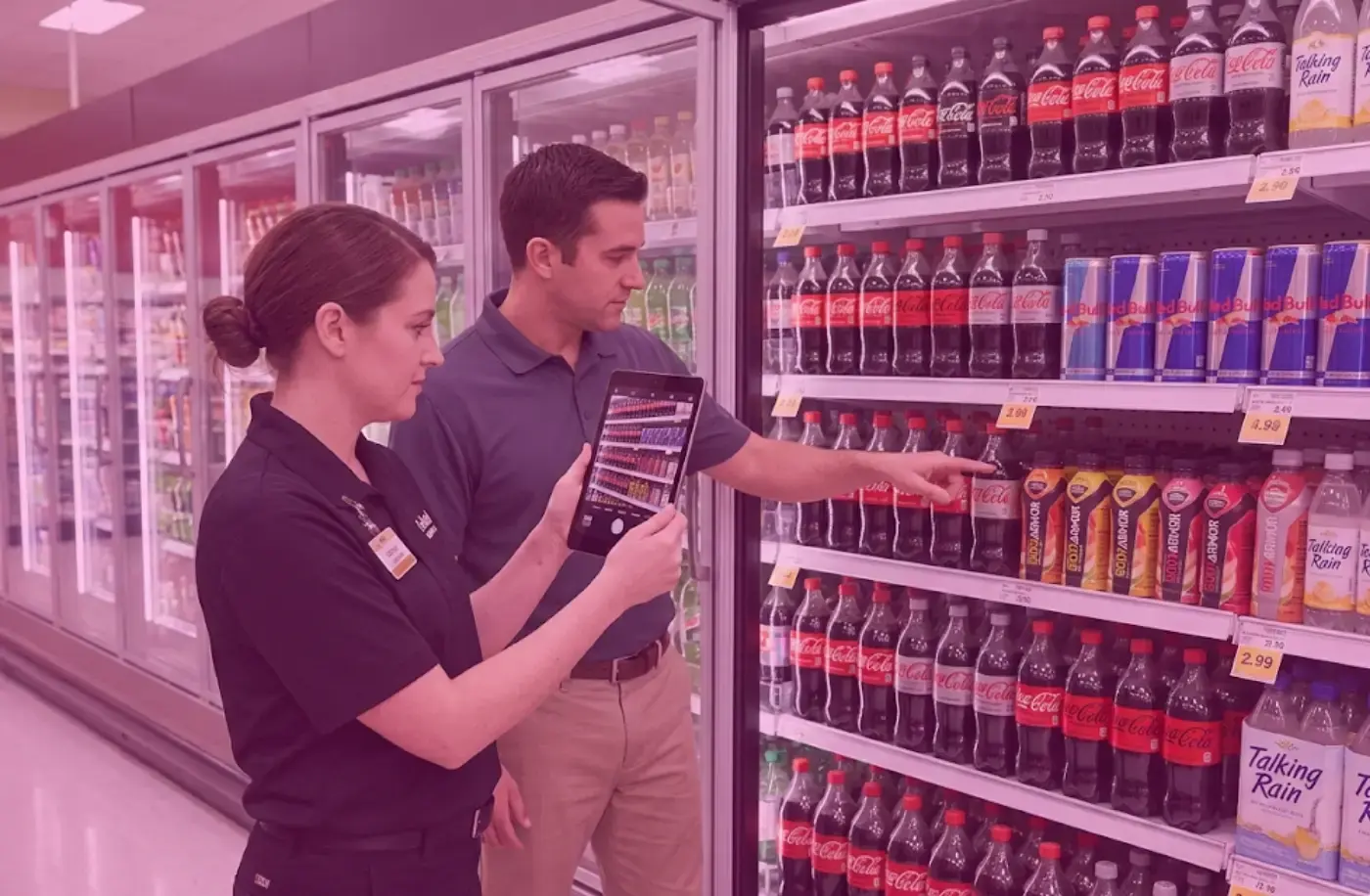
You already know your shelves aren't always compliant. What you probably don't know—with any precision—is how bad the gap is, where it's costing you the most, and how quickly your reps are catching it.
A regional sales manager at a top-five beverage company once described her situation this way: "We have 4,000 stores, 80 reps, and audit data that's three weeks old by the time it reaches my desk. By then, whatever was wrong is already wrong somewhere else."
That's the core problem retail image recognition software was built to solve. With IR software, Issues that used to surface in a monthly report get caught and corrected during the same visit.
This guide gives you a framework to evaluate retail image recognition software the right way—starting with the questions that determine real-world performance before you ever open a vendor proposal.
What Retail Image Recognition Software Does—And What It Doesn't
AI image recognition in retail is the use of computer vision—a form of artificial intelligence that reads and interprets photos—to analyze shelf conditions from a photo and return SKU-level compliance data during the store visit.
The core mechanic of image recognition software is straightforward:
A field rep opens an app, takes a photo of a shelf section, and the AI reads every visible product: what it is, where it sits, how many facings it has, and whether that matches the planogram on file. Deviations—a wrong product in position three, a missing price tag on a 2-litre, a competitor facing where your product should be—get flagged immediately. The rep sees a prioritized task list before leaving the aisle.
What changes between vendors is how accurately they read the shelf, how quickly the finding reaches the rep, and what the rep is actually expected to do with it.
What image recognition software does well:
- Identifies every SKU visible in a shelf photo—position, facing count, price tag, label orientation
- Compares the real shelf against the planogram assigned to that specific store
- Flags out-of-stocks, misplaced products, pricing errors, and competitor encroachments automatically
- Scores execution quality by store, banner, or region in a single dashboard
- Gets a prioritized fix list to the rep during the visit—not a report for a manager to review a week later
What it doesn't do:
- Fix a planogram that was built on the wrong assumptions before it reached the store
- Replace a rep's judgment on store relationships, category storytelling, or manager negotiation
- Solve a structural out-of-stock caused by a supply chain failure
- Guarantee field teams act on what they see—adoption is an operational challenge, not a technology one
If the shelf problem is compliance—the right plan exists but stores aren't executing it—image recognition closes that gap fast. If the plan itself is wrong, image recognition will surface that faster, but someone still has to fix the plan.
6 Questions To Ask Before You Look At Retail Image Recognition Vendors
You need to know what "good" looks like for your specific situation before you sit down with a vendor.
Ask these six questions first:
1. Does this system require us to supply our own product images and attribute data before it can recognize our SKUs?
Most tools need you to provide product images, dimensions, and UPC codes before their AI can recognize your products. That handoff takes weeks, sometimes months. Ask: what do you need from us on day one? The answer tells you the real implementation timeline before you sign anything.
2. What is your documented accuracy rate—and for which product categories and store formats?
Push past general numbers. Accuracy in ambient grocery is different from accuracy in a convenience cooler door with condensation. Ask for accuracy data for your specific category. Below roughly 90%, reps spend so much time manually verifying findings that most of the time-saving disappears.
3. What does the system do when a store doesn't have an official planogram on file?
Many CPG teams have coverage gaps—outdated planograms, new formats never mapped, retailers who never provided the file. Most image recognition tools can only benchmark compliance against a planogram. No planogram, no data. Ask if the system can benchmark against category norms or flag competitors without a reference file.
4. Does the finding reach the rep before they leave the aisle—or after?
A rep who sees a deviation flag while standing in front of the shelf fixes it during that visit. A manager who gets a report on Thursday about what happened Monday has already lost three days of sales. Ask vendors to walk you through the exact screen sequence from photo taken to fix actioned.
5. How does execution data connect back to your planogram and category planning workflow?
Execution data that never influences how you build the next planogram is solving half the problem. Ask: how does store-level data get back into planogram adjustments or assortment decisions? The answer tells you whether you're buying a point solution or something that makes the whole operation smarter over time.
6. Walk me through the first 30 days of implementation in detail—who does what, and what do we need to have ready?
Ask for a week-by-week breakdown. Then ask: what's the most common reason a deployment takes longer than you originally quoted? The answer is almost always something the vendor already knows. You want to hear it before you sign, not three months into an overrun.
Set Your Baseline Before You Talk To Anyone
Before the first vendor conversation, write down the specific numbers you'd want to move in 12 months. Set specific metrics with a current baseline.
Metrics worth baselining are:
- Current planogram compliance rate by banner—not an average, by banner
- Out-of-stock frequency for your top 20 SKUs, by store format
- Average time from a deviation detected to a deviation corrected
- Share of shelf versus your target share, by category
- Store visit coverage—what percentage of your store network gets visited in a given month
- Shelf photo submission rate per visit—how many sections are actually getting photographed
Once you have those numbers, your proof of concept (pilot) success criteria write themselves. You're not evaluating whether the software looks good in a demo, you're actually measuring whether compliance in a specific banner moved from 61% toward 85% in 90 days.
The metric most teams forget to baseline
How many shelf photos are reps actually submitting per visit?
Adoption rate is often the biggest driver of ROI—not the technology. The best image recognition system generates no value if reps photograph two of the twelve sets they walk past. Establish this number before you start, and ask every vendor to show you adoption data from a comparable deployment.
How To Run A Proof Of Concept (Pilot) That Tells You Something Real
A pilot is a time-limited test deployment—typically 30 to 100 stores, run for 6 to 12 weeks—to validate whether the tool delivers what you need before committing to full rollout. These are the parameters that matter.
Store count and geography
Run the pilot across at least 30 stores across a mix of formats—a grocery banner, a convenience channel, and one format where you know compliance is consistently bad. Fewer than 30 and you're testing three cooperative store managers, not whether the system scales.
Duration
Eight weeks minimum. The first two weeks are noisy as reps learn the system. You need at least six weeks of clean data to see trend lines, not just snapshots.
What to measure
Track three things: accuracy (how often does the system's read match what a human auditor confirms independently on the same shelf?), rep adoption (visits with photo submissions divided by total visits), and correction rate (deviations flagged versus deviations corrected within 48 hours).
The third number tells you whether the system is changing field behavior or just generating reports.
4 questions to ask the vendor during the pilot
- What accuracy should we expect in week two versus week six as the model learns our specific stores?
- What does your team actively do if adoption drops below a certain threshold in week three?
- Can you give us the raw detection data, not just the dashboard summary?
- Under what circumstances would you recommend we don't proceed to a full rollout?
That last question matters most. A vendor who gives you a straight answer understands their product's limits. One who deflects probably doesn't.
The Main Retail Image Recognition Vendors—What They Actually Do Well And Where They Fall Short
These are the players worth evaluating in 2026 if you're a CPG brand managing retail execution across a large store network:
Trax
Trax has been doing computer vision at retail scale longer than almost anyone. After merging with FORM (GoSpotCheck) in early 2025, the combined platform now covers both shelf analytics and structured field execution workflows.
The platform was built primarily for large retailers doing their own analytics, not for CPG brand teams managing field execution against their own planograms. Implementation is complex and slow—a VP of Retail Sales who needs reps fixing shelves in 30 stores within 30 days will feel that friction early.
Ailet
Ailet is strong in Latin America and has documented integrations with major retailers in that region. They claim 97% accuracy and connect well with Blue Yonder's planogram ecosystem. If a significant portion of your store network sits in LATAM, they deserve a look.
Their North American footprint is thinner, and the Blue Yonder dependency means the story is cleaner if you're already in that ecosystem.
Shelvz
Shelvz covers a broad set of retail execution use cases—planogram compliance, promotional tracking, mystery shopping, and image recognition. The breadth works if you want one tool covering multiple execution workflows.
The trade-off is that image recognition is one feature in a wider platform rather than the core technical focus. Published accuracy data by category isn't available.
Store360 by Vision Group
Store360 is built specifically around two problems: accuracy and speed of correction.
Most retail execution teams find out about a compliance problem when sales data catches it two or three weeks later. Store360 moves that detection into the store visit itself.
A field rep takes a shelf photo and gets back a compliance score, a deviation list prioritized by commercial impact, and a task to action—all before leaving the aisle. The compliance loop closes during the visit.
Two things separate it from most tools in this category:
First, it runs on a pre-trained library of over 1.3 million SKUs, so there's no product data handoff at the start of implementation—most clients are live in under 30 days.
Second, it benchmarks shelf presence against category norms and competitor positions even when no official planogram exists for that store, so coverage gaps don't create blind spots.
For example, L'Oréal deployed Store360 across Walmart locations where out-of-stocks were a persistent problem their reps couldn't directly fix. With photo evidence tied to sales impact data, store managers started acting faster. The result was $50K+ in replenishment orders across 10 stores in two weeks.
Barbara Kline, who leads retail execution at L'Oréal, said it plainly: "Inventory levels are going back up, sales are going back up, and it's really moving the needle."
Best fit: CPG brand teams with large, distributed retail networks where compliance detection is slow and out-of-stocks are a recurring commercial problem. Live in 55+ countries, runs on any device a rep already carries.
Not the right fit: If your primary gap is workforce scheduling or field training.
Retail Image Recognition Software: Head-To-Head On The Criteria That Matter
|
Criteria
|
Store360
|
Trax
|
Shelvz
|
Ailet
|
|
Needs your product data to start?
|
No—pre-trained
|
Yes
|
Yes
|
Yes
|
|
Works without an official planogram?
|
Yes
|
Limited
|
No
|
Limited
|
|
Documented accuracy rate
|
95%+
|
Strong
|
N/A
|
97% (claimed)
|
|
Fixes shelf during the same visit?
|
Yes
|
Limited
|
No
|
No
|
|
Connected to planogram + category tools?
|
Yes—native
|
Partial
|
No
|
Blue Yonder only
|
|
Live in under 30 days?
|
Yes
|
No
|
Yes
|
No
|
Red Flags To Watch For During The Sales Process
These aren't hypotheticals. They come up in real vendor evaluations and they're worth recognizing before you're deep into a process.
⚑ They quote an accuracy rate but can't show data for your category
"Our system is 97% accurate" means nothing without knowing: for which product category, in which store format, under which conditions. Ask specifically. If they can't produce it, the number doesn't exist for your use case.
⚑ The implementation timeline keeps expanding across calls
First call: four weeks. Scoping call: product data needed by week two. Technical call: IT needs to whitelist six domains. A vendor who doesn't know their own implementation timeline hasn't done this enough. That's a different risk than a slow timeline.
⚑ They deflect the planogram coverage gap question
If you flag that some stores don't have complete planogram files and the vendor changes the subject, they don't have that capability. It's a gap you can't work around post-deployment.
⚑ Their reference customers aren't in your vertical
Compliance dynamics in a beverage ambient set are different from personal care in a big-box store. If all three reference customers operate in different categories and formats, you may be their first real case study in yours.
⚑ The demo environment looks nothing like your actual stores
If the demo uses a perfectly lit ambient grocery shelf and your primary channel is convenience stores with poor lighting and narrow sets, send them a batch of your actual shelf photos before the demo and ask what they get back.
Questions To Bring Into Every Retail Image Recognition Software Vendor Conversation
The way different vendors answer the same questions tells you more than any feature comparison.
- What product data do you need from us before your system can recognize our SKUs?
- What's your documented accuracy rate for our specific category, and how was it measured?
- Walk me through what a rep sees from photo taken to fix actioned—show me the actual screen sequence.
- What does the system do for a store that doesn't have a planogram on file?
- How does execution data connect to planogram tools or category planning workflows?
- What's the most common reason a deployment takes longer than you originally quoted?
- What does your team actively do during the first 90 days—not the software, your people?
- What does rep adoption look like at week one versus week eight? What drives the difference?
- Can you show us pilot results from a client in our category, including the accuracy data?
- Under what circumstances would you recommend we pause a rollout rather than push through?
- If we need execution data in our BI stack, what does that technical connection look like?
- What's on your product roadmap for the next 12 months that's relevant to our use case?
Before You Request A Single Image Recognition Software Demo
Know which problem you're actually solving.
A retail execution manager at a beverage brand who needs reps fixing shelves in 5,000 convenience stores during the visit has a different decision than a category director who wants to understand compliance patterns across 40,000 grocery locations over six months. Both problems are real but the right tool for each is probably different.
Use the criteria in this guide to stress-test every vendor.
See How Vision Group’s Retail Image Recognition Software Store360 Works In A Live Store Environment
A 20-minute walkthrough. We’ll show you the product working in a real store: photo taken, shelf read, deviations flagged, rep action triggered.
→ Book a Store360 Walkthrough.
Retail Image Recognition Software FAQ:
1. What is retail image recognition software?
Retail image recognition software uses computer vision—a branch of artificial intelligence—to read shelf conditions in a store from a single photo. A field rep photographs a shelf section, and the software identifies every visible product, compares it against the approved planogram for that specific store, and flags deviations: a missing SKU, a mispriced item, a competitor encroaching on allocated space. Most platforms return that reading within 90 seconds directly on the rep's phone, during the store visit, before they leave the aisle.
2. How is image recognition different from a standard retail audit?
A manual shelf audit relies on a field rep checking each product against a checklist or their memory of what the shelf is supposed to look like—a process that's slow, inconsistent between reps, and limited by what one person can accurately observe while also managing a store relationship. Retail image recognition software replaces that manual checking step with an AI reading that's SKU-level accurate, consistent across every rep and every store, and delivered in seconds. The rep's job shifts from checking to fixing.
3. What metrics does retail image recognition software actually measure?
Retail image recognition software typically measures: planogram compliance (which products are in the correct position), out-of-stock rate (which products are missing from their assigned shelf slot), share of shelf (how much physical space your brand occupies versus competitors), pricing compliance (whether price tags match expected values), promotional display execution (whether secondary placements and in-store displays are in place and correct), and Perfect Store or PICOS scores (an overall execution quality rating by store, banner, or region). The specific metrics available vary by vendor—always verify against your specific KPIs before evaluating.
4. Does image recognition software replace field reps?
No—retail image recognition software changes what field reps do during a store visit, not whether they're needed. Instead of spending most of a visit manually checking product positions, the rep gets an AI-generated shelf reading within 90 seconds and spends their time on what the system can't do: fixing what's wrong, managing the store manager relationship, negotiating secondary placements, and handling escalations. The compliance analysis gets automated. The commercial judgment stays with the rep.
5. How accurate does retail image recognition software need to be to deliver ROI?
The practical accuracy threshold for retail image recognition software to deliver ROI is 90 to 95%. Below 90%, reps spend enough time manually verifying the system's findings that the efficiency gain largely disappears—you've automated the checking step but reintroduced it through verification. Above 95%, the system is reliable enough that reps can act directly on what it surfaces. When evaluating vendors, ask for accuracy data specific to your product category and store format. General accuracy numbers averaged across environments are not a reliable basis for comparison—a system that's 97% accurate in ambient grocery may perform very differently in a convenience store cooler door.
6. How long does it take to implement retail image recognition software?
Retail image recognition software implementation timelines range from two weeks to four months, and the single biggest variable is whether the vendor requires you to supply your own product master data—images, dimensions, and UPC codes—to train their models. If they do, expect 8 to 16 weeks before the system generates reliable readings for your SKUs. If the vendor maintains a pre-built product library that already covers your catalog, deployment can happen in 2 to 4 weeks. This is the most important question to ask before accepting any implementation timeline from a vendor.
7. What if we don't have complete planograms for all of our stores?
Incomplete planogram coverage is one of the most common gaps in large CPG retail networks—and it's a capability question worth asking every vendor directly. Most retail image recognition tools can only measure compliance against an official planogram file on record. No planogram, no compliance score, no flagged deviations for that store. A smaller number of tools can benchmark shelf presence against category norms and competitor positions even without a reference planogram, which means stores without complete planogram files still generate useful execution data. If planogram coverage is incomplete across a meaningful portion of your network, this capability is not optional—it determines whether you'll have structural blind spots from day one.
8. What's the difference between retail image recognition and retail execution software?
Retail execution software is the broader category—it covers any platform that helps field teams plan store visits, execute in-store tasks, and report back to HQ. Retail image recognition software is a specific capability within that category: it uses computer vision to read and analyze shelf conditions automatically from a photo. Some retail execution platforms include image recognition as one feature among many; others are built specifically around it. The distinction matters because a platform built primarily for visit scheduling and field workflow management solves a different problem than one built primarily for shelf compliance accuracy. If compliance accuracy and in-visit correction are your priority, a dedicated image recognition tool will typically outperform a broader platform where image recognition is secondary.
9. How do I know if my primary problem is compliance or field team productivity?
Run this diagnostic before evaluating any retail image recognition software. Pull a sample of stores with low compliance scores and check their visit frequency. If those stores are visited regularly but compliance is still low, the problem is the quality and speed of compliance detection—that's what image recognition solves. If your low-compliance stores are also your least-visited stores, the primary problem is field coverage and visit frequency—image recognition alone won't fix that. Buying a sophisticated shelf-reading tool when the real issue is that reps aren't getting to the store often enough is one of the most common misfits in retail tech procurement.
10. What should a retail image recognition pilot look like before full deployment?
A retail image recognition pilot—a time-limited test deployment to validate the tool before full rollout—should cover at least 30 stores across a mix of formats, run for a minimum of eight weeks, and measure three specific things: AI reading accuracy verified independently against human audits on the same shelves, rep adoption rate (store visits that produce usable compliance data divided by total visits), and correction rate (deviations flagged versus deviations corrected within 48 hours). Set your success thresholds before the pilot starts, not after reviewing the results. The adoption rate metric is the one most teams forget to track—and it's often the one that determines whether the deployment delivers ROI at scale.
11. What's the most common reason image recognition deployments fail to deliver ROI?
Low rep adoption. The technology works, but reps don't consistently take photos—or only photograph the easy shelves, not the problem sets. This is an operational challenge, not a technical one, and it needs to be addressed in the deployment plan with specific adoption targets, manager accountability, and sometimes gamified incentives. Ask vendors how they handle adoption during rollout; the quality of their answer tells you a lot about whether they've actually done this before at scale.
12. What is the best retail image recognition software for CPG brands?
The best retail image recognition software for CPG brands depends on three factors: how quickly you need to go live, whether you have complete planogram coverage across your store network, and whether you need the execution data to connect back into category planning tools. Store360 from Vision Group is built specifically for CPG brand teams managing execution across large retail networks—it runs on a pre-trained library of over one million SKUs so implementation typically takes under 30 days, works without an official planogram on file, and connects execution data directly to assortment planning. But the right fit depends on your specific priorities.
13. What is the ROI of retail image recognition software?
The ROI of retail image recognition software comes primarily from three sources: recovered sales from faster out-of-stock detection, recovered revenue from compliance deviations caught and corrected during the visit rather than weeks later, and field efficiency gains from replacing manual checking with automated AI readings.
The most direct way to build the business case is to establish your current planogram compliance rate by banner, estimate the revenue impact of the compliance gap using share-of-shelf and velocity data, and then model what a 10 to 15 percentage point improvement would recover.
L'Oréal's retail execution team secured $50,000+ in replenishment orders across just 10 Walmart stores in two weeks after deploying Store360. The size of the ROI depends on your current compliance gap and category velocity, but the calculation is straightforward once you have the baseline data.