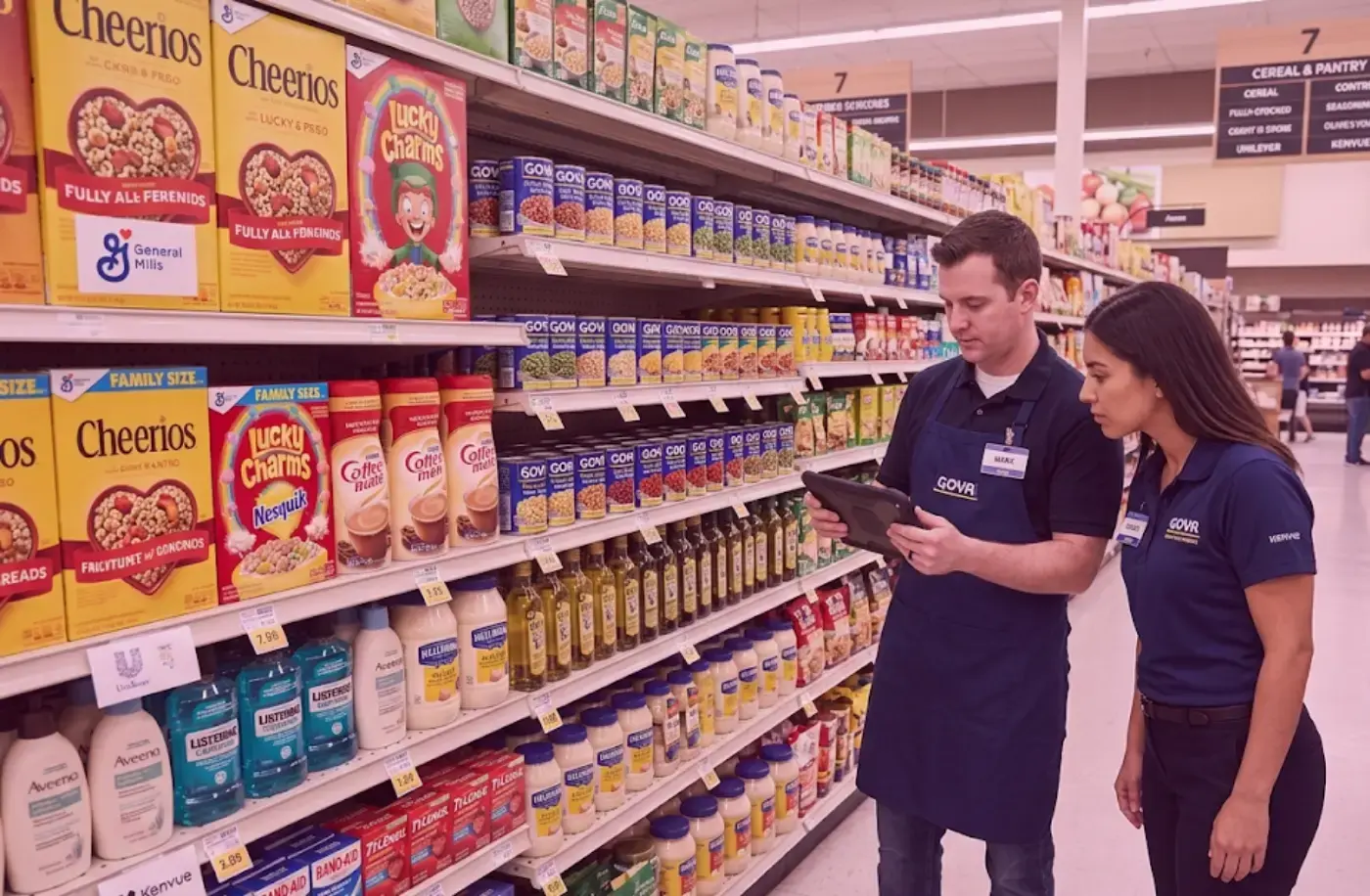
Out-of-stocks remain the most expensive and persistent problem in physical retail. The IHL Group estimates that OOS costs the global retail industry $1.1 trillion annually. For CPG brands, out-of-stocks do not just reduce today revenue. They erode shopper loyalty, distort demand forecasts, and give competitors shelf space they did not earn.
The traditional response has been more frequent manual audits, better communication with retailers, and improved supply chain forecasting. These approaches help, but they share a fundamental flaw: they are reactive. By the time a human identifies an empty shelf, the revenue is already lost. The shopper has already walked away, switched brands, or bought from another store.
Artificial intelligence changes the equation by making out-of-stock detection continuous, automated, and connected to corrective action. This guide explains how AI-powered OOS detection works, why most implementations fail to deliver ROI, and what a complete solution looks like in practice.
The Real Cost of Out-of-Stocks
The headline number is staggering, but the mechanics underneath are what matter for CPG brands managing execution across thousands of stores. When a product is out of stock, four things happen simultaneously. First, the immediate sale is lost. A shopper who intended to buy your product either substitutes a competitor, delays the purchase, or buys nothing. Studies consistently show that 21-43% of shoppers will buy a substitute product from a different brand when their first choice is unavailable.
Second, the demand signal is corrupted. If your product sold zero units on Tuesday because it was not on the shelf, your demand forecasting model records zero demand for Tuesday. This creates a downward spiral: the forecast models predict lower demand, which leads to lower replenishment quantities, which increases the probability of future out-of-stocks. This is the OOS feedback loop, and it quietly destroys forecast accuracy over time.
Third, retailer relationships suffer. Retailers allocate shelf space based on sales velocity. If your product shows weak velocity because it was frequently out of stock, the retailer may reduce your facings or delist the product entirely. You lose shelf space not because demand was weak, but because execution was weak.
Fourth, the field team wastes capacity. Manual OOS detection requires reps to physically visit stores, scan shelves, identify gaps, report them, and hope the issue gets resolved before the next visit. This is expensive, slow, and catches problems after they have already cost you revenue.
How AI Out-of-Stock Detection Works
Modern AI-based OOS detection uses computer vision to identify products present on the shelf and flag gaps. A field representative, store associate, or fixed camera captures an image of the shelf. The AI model processes the image, in real time, typically under 5 seconds, identifying every visible product by SKU. The system compares what is present against what should be present and flags any missing products as potential out-of-stocks.
The technology has matured significantly. Current-generation platforms like Store360 use a fusion training approach: real-world shelf data from 1 billion+ images, synthetic data generation, generative AI pipelines, and zero-shot and few-shot learning. This means new products can be onboarded in under 24 hours through HOLOBOX fast-track training rather than waiting weeks for field capture. The OmniPix library of 1 million+ SKUs with six views per UPC provides the foundation. Store360 achieves 95%+ accuracy in real-world store conditions, works offline on mobile devices, and returns real-time results in under 5 seconds.
But detection accuracy alone does not reduce out-of-stocks. The critical question is what happens after detection.
Why Most AI OOS Solutions Fail
The majority of AI image recognition deployments in retail follow a detect-and-display pattern. The system identifies an out-of-stock. It populates a dashboard. A manager reviews the dashboard, usually hours or days later. The manager manually assigns a corrective task. Eventually, someone restocks the shelf.
This workflow is better than no detection at all, but it introduces latency at every handoff. The gap between detection and resolution can be 24 to 72 hours. For fast-moving consumer goods in high-traffic stores, that delay represents thousands of dollars in lost sales per incident.
The problem is architectural. If your image recognition system and your task management system and your demand forecasting system are three separate products from three different vendors, every OOS event requires manual coordination across platforms.
The Agentic Execution Approach
Vision Group takes a fundamentally different approach. When Store360 detects an out-of-stock, the system does not wait for human intervention. Execution.AI autonomously initiates a response chain. A prioritized corrective task is generated and assigned to the appropriate field rep based on proximity, route, and workload. A replenishment signal is sent to the relevant supply chain system. Assortment.AI updates the demand forecast to account for the OOS period, preventing the corrupted demand signal from distorting future predictions.
This closed-loop architecture means the time between detection and corrective action initiation is measured in seconds, not days. The field rep receives an actionable task on their mobile device with specific instructions. When they resolve the issue, Store360 verifies the fix with a follow-up image capture.
The results across Vision Group customer base are measurable. Clients report a 22% average reduction in out-of-stock rates, 10-20% category sales increases in stores with AI-enabled execution, and over 600,000 field hours saved annually. These are production results from 340+ enterprise customers in 75+ countries.
What to Look for in an AI OOS Solution
Five criteria separate effective solutions from expensive dashboards. First, high accuracy in real store conditions. Second, results fast enough for same-visit correction. Third, no planogram-on-file requirement. Fourth, detection connected to action: tasks, replenishment, and forecast correction. Fifth, ask how the model is trained and how fast new SKUs are onboarded. Systems relying on a single training method have blind spots: synthetic-only misses messy shelf reality, real-images-only is slow to onboard. Look for a fusion approach combining real-world data, synthetic generation, generative AI, and zero/few-shot learning backed by a large proprietary product library.
The Bottom Line
Out-of-stocks are not an information problem. They are an action problem. The revenue is lost in the gap between detecting the empty shelf and restocking it. AI image recognition solves the detection side. Agentic execution solves the action side. Together, they transform OOS from an accepted cost of business into a measurable, reducible, and increasingly automatable challenge.
The shelf does not wait for a dashboard review. Your AI should not either.
Book a 30-minute demo with the Vision Group team. No configuration required before the call.