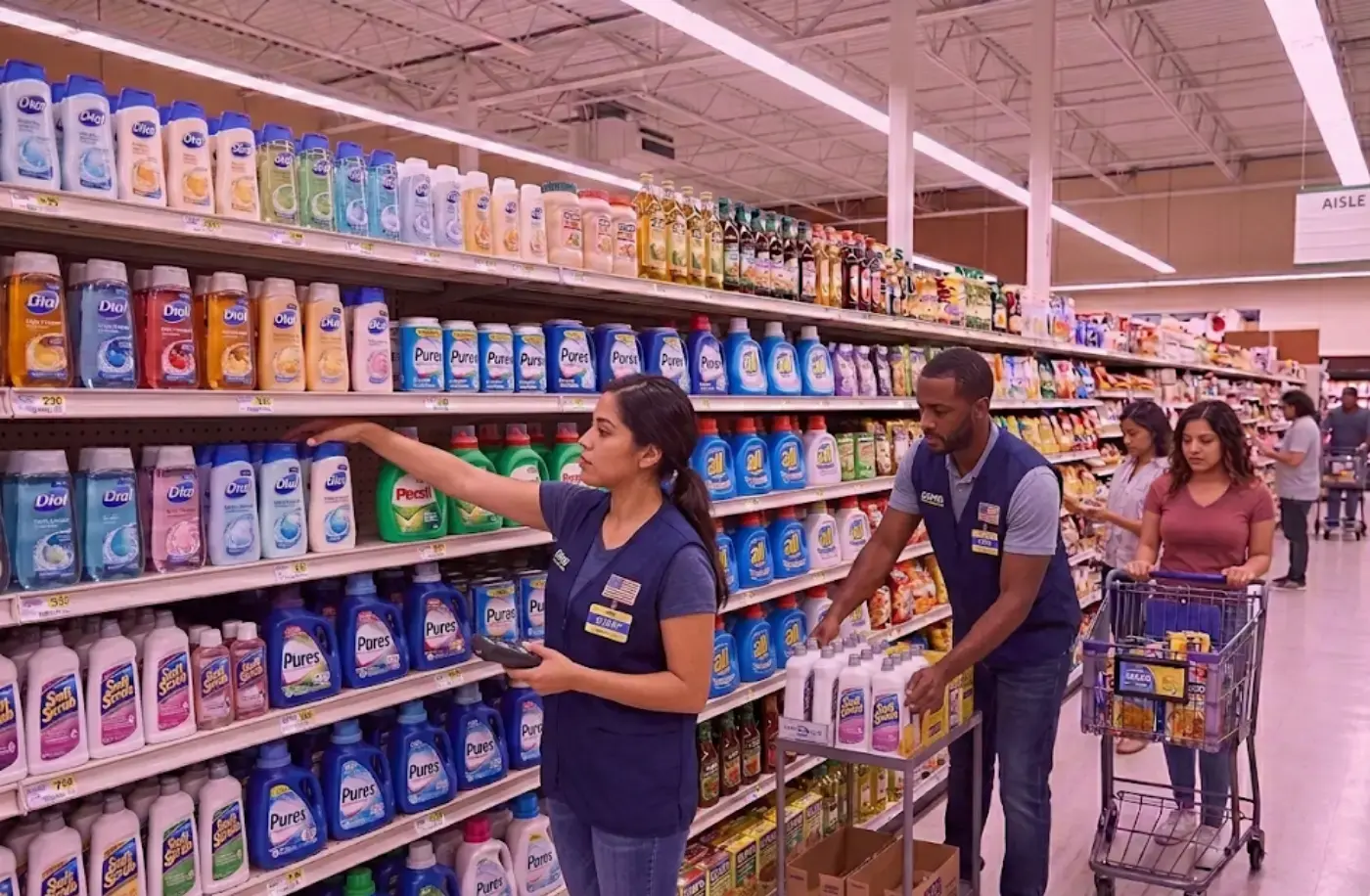
Shelf intelligence is the use of AI-powered computer vision and IoT sensors to analyze store shelves in near real time—converting shelf photos into structured data on product presence, planogram compliance, share of shelf, and out-of-stocks.
For trade marketing directors, VPs of Retail Sales, and regional field managers, it is the operational layer that connects what headquarters plans to what field teams actually execute.
What Is Shelf Intelligence?
Shelf intelligence is the capability that converts shelf photos into structured retail data—automatically, using AI-powered computer vision—and delivers that data to field teams and HQ fast enough to act on it during the same store visit.
A field rep photographs the shelf during a standard store visit, or a fixed camera captures a continuous feed from an always-on installation. An AI model processes the image in seconds, identifies every product by its packaging, and maps what it sees against the expected planogram.
The output is structured data: which SKUs are present, how many facings each holds, what the compliance score is for each bay, and a prioritized list of deviations with specific fix instructions. That data reaches the field rep before they leave the store, and the regional sales manager and trade marketing team at HQ by end of day.
The distinction from older forms of shelf monitoring is the feedback loop. Syndicated scanner data tells you what sold. Shelf intelligence tells you what is on the shelf right now—and what needs to change before the next sale is missed. Understanding that starts with the 5 data categories shelf intelligence captures on every store visit.
What Data Does Shelf Intelligence Capture?
Shelf intelligence platforms generate 5 categories of structured data from shelf images. Each category serves a different decision-maker in your organization.
1. Product Presence and Out-of-Stocks
Shelf intelligence identifies which SKUs are on the shelf and which positions are empty, down to the specific bay and shelf level. A regional sales manager gets a store-by-store gap report fast enough to dispatch a rep or trigger a replenishment order the same day.
Without shelf intelligence, those gaps remain invisible until the next scheduled audit—which could be three to four weeks away. By then, the lost sales are already counted.
2. Planogram Compliance
Shelf intelligence confirms whether each SKU is in the right shelf position, at the right facing count, and in the correct sequence against the approved planogram. This tells trade marketing teams whether the standards they set are actually being followed at store level—and which stores need a field correction.
A compliance score by store, by region, and by retailer chain gives HQ a network-wide view in hours, not months.
3. Share of Shelf
Shelf intelligence measures how many linear facings your brand holds versus competitors in the same category, by store. Account management and trade marketing teams use share of shelf data to enter retailer reset negotiations with current, store-level numbers—not estimates based on the last planogram they received.
4. Promotional Execution
Shelf intelligence confirms whether secondary displays are in place, promotional price tags are posted, and point-of-sale materials are present. A VP of Sales who approves a national promotion can see within 48 hours whether it's executing correctly—while there's still time to fix stores that are falling short.
5. Competitor Activity
Shelf intelligence captures competitor facing counts, detects intrusions into your allocated shelf space, and identifies new SKU placements by adjacent brands. A trade marketing manager making a case for additional shelf allocation needs to show current shelf reality—not a planogram document from the last category review.
A note on capture methods: Most CPG deployments combine two modalities. Visit-based capture has field reps photograph the shelf as part of their standard store visit workflow. Fixed-camera and video-based installations provide a continuous feed from always-on equipment—common in high-priority accounts and beverage cooler environments. Both feed the same AI recognition pipeline and produce the same structured data outputs.
All of that data is only valuable if it arrives in time to act on it. That is where real-time processing makes the difference.
How Real-Time Shelf Data Drives In-Store Decisions
"Real-time" in shelf intelligence has a specific operational meaning: the gap between a shelf photo and a correctable alert is measured in minutes—not the gap between a manual audit and a quarterly data delivery.
Here is how the decision chain works in practice.
- Field rep photographs the shelf as part of their standard store visit.
- AI processes the image in seconds and scores compliance by bay. If a SKU is missing, out of position, or a competitor has intruded into allocated space, an alert is generated with a specific fix instruction.
- Rep corrects it on the same visit. The fix is logged, timestamped, and visible to the regional sales manager within minutes.
- HQ sees aggregate compliance data by end of day—which chains are executing, which regions are underperforming, which stores need a priority visit next week.
"You don't want data four weeks from now because it's too late to make a decision. You want accurate, up-to-date information."
— Senior CPG industry executive, 30 years in retail
That feedback speed changes what's operationally possible. A promotional launch that's failing to execute can be corrected in week one—not discovered in the post-campaign review. A compliance gap at a key account can be fixed before the retailer flags it. Out-of-stocks that would have persisted through a four-week data lag get caught and resolved the same day they appear.
Shelf intelligence does not replace the field team. It makes each store visit count more: the rep arrives knowing exactly what to fix and leaves with the fix confirmed. That precision is what turns shelf data into revenue decisions.
How CPG Brands Turn Shelf Photos into Revenue Decisions with Shelf Intelligence
The operational improvements shelf intelligence delivers—faster compliance corrections, same-day out-of-stock alerts, real-time share of shelf data—translate directly into revenue decisions. Here are three ways that plays out in practice.
- Replenishment decisions: When a top-5 beauty brand deployed Store360 across 10 Walmart stores, shelf photo analysis surfaced replenishment gaps the trade marketing team had no way to see through their existing reporting. They placed over $50,000 in replenishment orders within two weeks. The stores had not changed. The data had.
- Field correction decisions: A pizza brand confirmed that front-facing product placement drove a 20% increase in sales when correctly executed. Shelf intelligence then revealed that 70% of stores in the network were not executing the standard. The trade marketing team sent targeted corrections to those specific stores—not a blanket directive to the entire network.
- Trade negotiation: CPG brands using Store360 have reduced out-of-stocks by 22% across their networks. A national account manager walking into a shelf reset discussion with a retailer can show current share of shelf data, execution compliance rates, and out-of-stock reduction as evidence—instead of relying on historical sell-through data alone. That is a different kind of conversation.
Knowing how shelf intelligence performs in practice makes it easier to evaluate platforms with the right expectations. The next section covers the six criteria that separate reliable platforms from ones that look good in a demo.
What to Look for in a Shelf Intelligence Platform
Six things worth verifying before you commit to a platform.
- Field-validated production accuracy—not demo accuracy. Accuracy measured on curated test images will always be higher than accuracy in live stores with real shelf clutter, motion blur, and lighting variation. Ask for field-validated production accuracy specifically—that is the number that determines whether your compliance data is trustworthy.
- A pre-trained SKU library deep enough to cover your categories. If your SKUs are not already in the library, you are signing up for a model training project before you see production data. The difference between a shallow library and a deep one is weeks of setup time versus same-week deployment.
- Image processing measured in seconds per image. Batch-processed overnight means your field rep cannot act on the results during the visit that generated them. For shelf intelligence to enable same-visit corrections, processing must complete in seconds—not hours.
- Alert routing to the field rep and their regional manager. A compliance gap that reaches a dashboard no one opens is the same as no alert. Confirm that specific alerts—with specific fix instructions—route to the field rep at store level and to their manager for oversight.
- An implementation timeline of 30 days or under. A platform that takes six months to deploy is an IT project, not a field tool. Thirty days from contract to first production data is achievable. If a vendor quotes a quarter or more, factor in the promotional windows you will miss while waiting.
- Integration with existing field workflows. Your reps already have phones and established visit routes. A platform that requires a separate device or login will not get consistent use. Shelf intelligence that fits into the tools your reps already open on every visit is shelf intelligence that actually generates data.
How to Assess Your Current Shelf Execution Gap
Evaluating a shelf intelligence platform is easier when you know what you are actually solving for. These five questions help trade marketing directors and VPs of Retail Sales quantify their current execution gap before any vendor conversation.
1. How long does it take you to know an out-of-stock exists at store level?
If the answer is "the next scheduled audit" or "when the sales data shows a dip"—you are typically finding out two to six weeks after the gap opened. Every week a facing sits empty is a week of lost revenue per store, per SKU, across every store in your network where it is happening.
2. What percentage of your stores are executing your current planogram correctly?
If you do not have a number, that is the gap. Your trade marketing team has invested time building planogram standards. Without compliance data coming back from stores, there is no way to know whether those standards are driving results or sitting unexecuted in a shared folder.
3. How many stores does your field team physically cover per visit cycle versus your total network size?
Divide your average weekly store visits by your total store count. That ratio tells you what percentage of your network is effectively invisible between visit cycles—stores where compliance failures, out-of-stocks, and competitor activity have no way to surface to HQ.
4. How long after a promotional launch do you know whether it is executing correctly?
If the answer is more than five business days, you are funding a promotion you cannot confirm is running. Most post-campaign reviews happen after the promotional window has closed—which means any corrections arrive too late to recover the spend.
5. How are you currently tracking competitor activity at the shelf level?
If the answer is "we ask reps to flag it during visits"—that is anecdote, not data. Competitor intrusions into your allocated space, facing gains by adjacent brands, and new SKU placements are happening between visit cycles with no systematic record.
If you could not answer more than two of these questions with a specific number, your execution gap is likely larger than your current sales data reflects. The revenue impact shows up in reports—but without shelf-level data, the cause stays invisible until the damage is already counted.
A simple way to size the exposure: take your estimated out-of-stock rate, multiply it by average weekly revenue per affected SKU per store, then multiply by your total store count. That is your weekly revenue at risk from out-of-stocks alone—before factoring in compliance failures, unexecuted promotions, or lost shelf space. Once you have that number, the conversation with a shelf intelligence vendor becomes concrete.
Brands running Store360 across their networks have reduced out-of-stocks by 22%.
Store360 by Vision Group—Shelf Intelligence Built for CPG Execution
Store360 is Vision Group's shelf intelligence platform, built specifically for CPG brands managing execution across large retail networks. It is used by trade marketing directors, VPs of Retail Sales, and field sales leadership who need shelf data that arrives fast enough to act on.
Platform highlights:
- 95%+ field-validated production accuracy—measured in live store environments, not test conditions
- 1.3M+ pre-trained SKUs—covering major CPG categories so most brands generate production-quality data from the first store visit
- Live in 30 days or under—most clients are up and running within 30 days; some in two weeks
- 22% fewer out-of-stocks across the Store360 client base
- 600,000+ field hours saved annually—time previously spent on manual audit entry and reporting
- Named clients: Coca-Cola, Nestlé, L'Oréal, Kenvue, Henkel, Mars, Red Bull, Goya, Wegmans.
"We're the only people with a full end to end—this is what should be done, this is what happened, and here's how I can measure it." —Senior CPG industry executive
Store360 is part of the broader Vision Group platform, which includes planogram automation (EZPOG, PicToPOG), assortment optimization (Hivery Curate), product digitization (OmniPIX), and IoT and autonomous retail monitoring for always-on shelf and cooler coverage. For CPG brands that need shelf intelligence as one layer of a full execution and planning system, Vision Group connects the entire chain from planning to shelf.
→ See Store360 in action—book a walkthrough.
Shelf Intelligence FAQ:
What is shelf intelligence in retail?
Shelf intelligence in retail is the use of AI-powered computer vision or IoT sensors to analyze store shelves in near real time. It converts shelf images into structured data—covering product presence, planogram compliance, share of shelf, and out-of-stocks—and delivers that data to field teams and HQ fast enough to act on during the same store visit.
What is the difference between physical shelf intelligence and digital shelf intelligence?
Physical shelf intelligence monitors what is happening on the in-store shelf: product presence, planogram compliance, out-of-stocks, share of shelf, and competitor activity—captured from shelf photos or fixed cameras and processed by AI. Digital shelf intelligence is a separate category that monitors a brand's presence on retailer websites: product content accuracy, search ranking on retailer.com, online pricing, and digital availability. The two serve different teams and different decisions.
How does AI-powered shelf intelligence work?
A field rep photographs the shelf, or a fixed camera captures a continuous feed. An AI computer vision model processes the image in seconds, identifies every product by its packaging, maps what it sees against the expected planogram, and generates structured outputs: facing counts, compliance scores, share of shelf, and out-of-stock flags. The data is routed to the field rep for same-visit action and to the regional manager and HQ team for network-level reporting.
What data does a shelf intelligence platform capture?
Shelf intelligence platforms capture five data categories: product presence and out-of-stocks (which SKUs are on shelf and which positions are empty), planogram compliance (right SKU, right position, right facing count), share of shelf versus competitors, promotional execution status (secondary displays, price tags, POS materials), and competitor activity including space intrusions.
What is real-time shelf intelligence?
Real-time shelf intelligence means shelf photos are processed in seconds and compliance alerts reach the field team during the store visit that generated them. It enables same-visit corrections—a rep can identify and fix a compliance gap before leaving the store—rather than scheduling corrections for the next visit or waiting for an audit cycle.
How does shelf intelligence reduce out-of-stocks?
Shelf intelligence identifies empty shelf positions by SKU and by store, then routes alerts to the regional sales manager or field rep fast enough to trigger a same-day replenishment action. Out-of-stocks are caught during the visit that surfaces them—or within hours of one—instead of being discovered in aggregated sales data weeks later after the revenue impact has already been counted.
What is CPG digital shelf intelligence?
In the CPG context, digital shelf intelligence most often refers to AI-powered in-store shelf monitoring—the category covered in this guide. In some contexts it also refers to e-commerce monitoring tools that track a brand's product listings on retailer websites. When evaluating platforms, confirm which category a vendor is operating in, because the data they deliver and the teams they serve are different.
How is shelf intelligence different from a manual store audit?
A manual store audit runs on a fixed schedule, covers a sample of stores, and produces results days after the visit. Shelf intelligence is generated from standard field rep visits using a mobile app, processes in seconds, covers every store on every visit, and delivers results the same day. A manual audit produces a report. Shelf intelligence produces a correctable alert specific enough for a field rep to act on before they leave the store.
What should I look for in shelf intelligence software?
Six criteria: field-validated production accuracy (not demo accuracy), a pre-trained SKU library that covers your categories on day one, image processing in seconds per image, alert routing to both the field rep and their regional manager, an implementation timeline of 30 days or under, and integration with the mobile tools your field reps already use.
How long does it take to implement a shelf intelligence platform?
The main factors are whether your SKUs are already in the pre-trained library, the number of stores in the initial rollout, and whether the platform integrates with your existing field app. Thirty days from contract to first production data is achievable. Some implementations complete in two weeks. If a vendor quotes a full quarter or longer for initial deployment, factor in the promotional cycles and sales windows you will miss waiting for it to go live.
What is an AI agent for shelf intelligence?
An AI agent for shelf intelligence is an autonomous system that goes beyond analyzing shelf photos to triggering downstream actions—filing replenishment orders, generating field visit briefs, or updating compliance records—without requiring human review of each alert. Most deployed shelf intelligence platforms today still route alerts to a human before action is taken. Agentic shelf intelligence is an emerging capability that a small number of platforms are beginning to build toward.