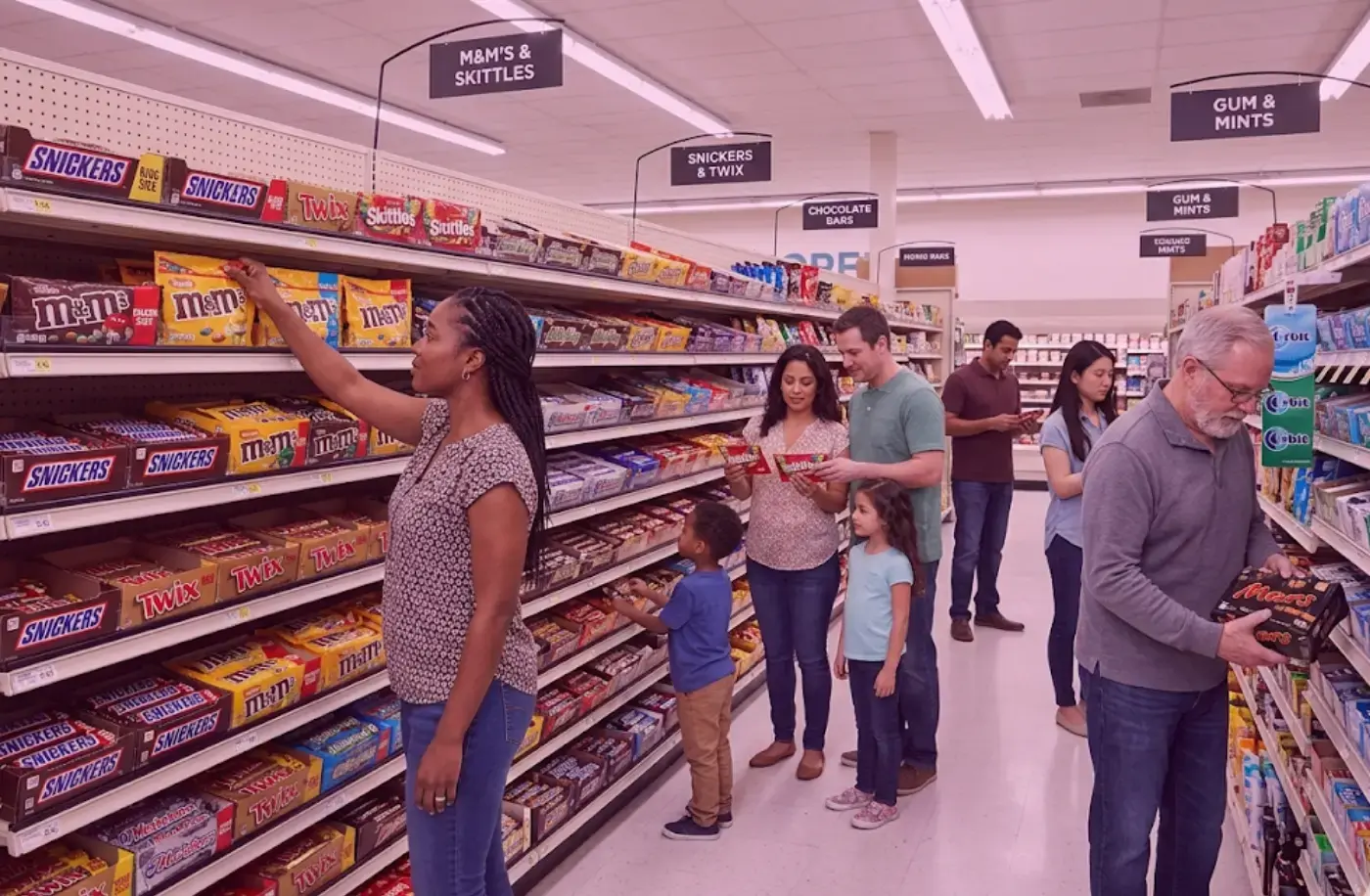
A category manager's job is to put the right products on the right shelf at the right time—and prove to a retail buyer that the recommendation is worth the space. Category management software exists to make that job faster, more defensible, and measurable all the way to the store floor.
This guide breaks down what the platform should do at each stage.
What Is Category Management Software?
Category management software is the platform that helps CPG brands and retailers decide which products belong on a shelf, how those products should be arranged to maximize category performance, and whether those decisions are being executed correctly in stores. It turns category strategy—built from sales data, market trends, and retailer goals—into shelf layouts that field teams can execute and that retail buyers can approve.
A complete platform gives category managers the ability to:
- Simulate assortment scenarios before a reset,
- Build retailer-ready planograms from those decisions, and
- Verify that what was planned is what stores are actually executing—all from one connected system.
That means a category manager can walk into a line review with a forward-looking recommendation, submit a planogram the same day, and confirm execution compliance within 24 hours of a field visit.
That workflow runs across five capabilities: assortment optimization, space planning and planogram creation, category analytics, AI and scenario modeling, and execution verification.
The following section covers what each one should enable your team to do.
What a Complete Category Management Platform Should Do for Your Team
Category management software is not a single tool—it is a stack of connected capabilities. Here is what each one should deliver, who on your team it serves, and why it matters commercially. Use this as your benchmark when evaluating any platform.
Layer 1: Assortment Optimization
Assortment optimization gives category managers the ability to build a defensible assortment recommendation before any reset—running scenario simulations that model the revenue and margin impact of adding or removing SKUs, so the recommendation going to the retail buyer is backed by projected financial data rather than historical sell-through.
A category captain with assortment optimization can walk into a line review having already modeled the buyer's objections.
Layer 2: Space Planning and Planogram Creation
Space planning and planogram creation lets category managers and space planning teams build retailer-ready shelf layouts in hours—using accurate product dimensions from a pre-built SKU library, in the file formats each retail account accepts. A connected platform means the approved assortment feeds the planogram automatically, so the layout reflects the category decision without a separate manual build. Retailers get a submission they can act on.
Your team gets hours back from every category review cycle.
Layer 3: Category Analytics and Insights
Category analytics and insights gives category managers and trade marketing directors a financial view of category performance—SKU velocity, margin per linear foot, promotional effectiveness—tied directly to the assortment and planogram decisions they are making.
When analytics and assortment optimization run from the same source, a category manager walks into a retailer meeting with a recommendation and the financial evidence for it built from one consistent data model—not from two tools that needed reconciling the night before.
Layer 4: AI and Scenario Modeling
AI and scenario modeling gives category managers the ability to simulate dozens of assortment scenarios in minutes—modeling the revenue and margin impact of SKU changes, demand shifts, and space reallocation before any decision is finalized. Legacy tools tell a category manager what happened last quarter. AI scenario modeling tells them what will happen if they make a specific change, with projected financial data to back it.
A category manager using this capability arrives at a line review with a forward-looking recommendation already stress-tested against the buyer's likely objections.
Layer 5: Execution Verification
Execution verification gives trade marketing directors and VPs of Retail Sales visibility into whether the approved category plan is actually executing in stores—by store, by region, by chain—fast enough to correct non-compliant stores while a promotion is still running. Field reps photograph the shelf during standard store visits, AI processes the images in seconds, and HQ sees a network-wide compliance view the same day.
CPG brands running Store360 across their networks have reduced out-of-stocks by 22%—and use that same execution data to enter retailer reset negotiations with current performance numbers, not historical sell-through.
"We're the only people with a full end to end—this is what should be done, this is what happened, and here's how I can measure it."
— Senior CPG industry executive, 30 years in retail
What AI Category Management Software Makes Possible
AI category management software gives CPG teams three capabilities that legacy tools, however well-configured, cannot replicate. These are the capabilities worth asking about in any vendor evaluation.
Scenario simulation at speed
Legacy category management tools produce reports based on historical performance. AI category management software simulates alternative scenarios before any decision is made.
A category manager preparing a line review can ask the platform to model what happens to category volume and margin if three slow-moving SKUs are replaced with two faster-moving items—and get a projected financial output in minutes, not after a day of spreadsheet work.
Curate, Vision Group's assortment optimization platform, applies this directly. Category managers run scenario modeling before any reset—so the recommendation going to the retail buyer is backed by simulation data, not a static analysis of last quarter's sell-through.
Predictive demand, not just historical data
Machine learning category management software identifies demand signals before they appear in POS data—analyzing velocity trends, market data, seasonal patterns, and adjacent category performance to forecast which SKUs are gaining momentum and which are declining.
A category captain who surfaces a growth trend in their category submission before the retailer's own data shows it has a fundamentally different conversation with the buyer than one presenting historical scan data.
Agentic execution intelligence
The most recent development in AI category management software is agentic AI—systems that do not just generate insights but take or recommend specific actions.
Store360's AI Agent, for example, generates a prioritized list of the specific stores that need attention today, ranked by estimated revenue impact, with fix instructions loaded into the field rep's mobile workflow before they leave the office.
That shift—from insight to action—is what distinguishes agentic AI category management tools from platforms that surface data and expect a human to decide what to do with it.
What Category Management Software Enables for CPG Brand Teams
The same platform serves three different roles at different stages of the category management workflow. Here is what each role should be able to do with the right platform in place.
Prepare retailer line reviews
With the right platform, a category manager preparing a line review can run multiple assortment scenarios, generate a retailer-ready planogram from the approved scenario, and produce financial projections—all from one data model, in the same workflow. The submission that goes to the retail buyer reflects the latest thinking, not a version that was current three rounds of revisions ago.
That workflow is what Curate and EZPOG deliver together. Curate handles the assortment simulation and financial modeling. EZPOG generates the planogram from that output. When the category manager adjusts the scenario, both update from the same source—so the preparation time for a major line review shrinks from days to hours.
Manage promotional execution
With execution verification in place, a trade marketing director who approves a promotional layout on Monday can see which stores are executing it correctly by Wednesday—and dispatch field corrections to the ones that are not while the promotion is still running. That is the difference between measuring promotional ROI after the fact and actually managing it in real time.
Store360 delivers this. Field reps photograph the shelf during standard store visits, AI processes the images in seconds, and the trade marketing team sees a network-wide compliance view the same day—with specific stores flagged for corrective visits while the promotional window is still open.
Manage shelf allocation negotiations
With execution data behind them, a VP of Retail Sales enters a shelf reset negotiation with current share of shelf numbers, compliance rates, and documented out-of-stock reduction—not a planogram document from the last category review. That changes the weight of the conversation. A retail buyer can dismiss a recommendation. They cannot easily dismiss network-wide performance data showing what the brand's execution looks like right now.
CPG brands running Store360 have reduced out-of-stocks by 22% across their networks. A national account manager who can show that number—with store-level data behind it—is negotiating from a position that a brand without execution visibility simply cannot reach.
7 Things to Demand from a Category Management Platform Before You Sign
Most vendors will show you what their platform can do. These seven questions help you confirm it does what your team actually needs—before a demo becomes a contract.
1. Assortment and planogram should run from one data model
When you approve an assortment change, the planogram should update from the same source—not require a separate rebuild. Ask the vendor to show you what happens when you modify the assortment: does the planogram reflect the change automatically, or does someone on your team need to rebuild it manually?
2. The AI should simulate, not just report
In the demo, ask the vendor to show you a scenario simulation with your category's constraints—not a case study. If the AI produces a chart of historical performance, it is an analytics tool. If it produces a projected financial outcome for a specific assortment change you propose, it is generative AI.
The difference is whether the platform helps you decide, or just shows you what already happened.
3. You should be able to confirm execution, not just approve the plan
Ask: after a planogram is approved, how does your team know whether stores are executing it correctly? The right answer involves field image data coming back against the approved layout—not a PDF sent to field teams and a follow-up call three weeks later.
4. Your SKUs should be in the library before your first store visit
Ask the vendor to run your brand portfolio against their pre-built SKU library before you sign. A deep library means your team is generating production outputs from day one. A shallow one means your first weeks are spent uploading product data before a single layout gets built.
5. Your category managers should be building real layouts within a week
Ask specifically: how long from contract signature to the first production planogram built by one of our category managers? Cloud-based platforms with pre-built libraries should answer in days. If the answer involves IT, data migration, or training programs measured in weeks, factor that into the evaluation.
6. Implementation should require your category team, not your IT team
A cloud-based platform that runs in a browser means your category managers can build, share, and update planograms from any device without raising a ticket. Ask which roles are required for setup and how many hours they will need to commit before the platform is generating production outputs.
7. One platform should cover your full workflow
Ask how many other tools your team would still need alongside this platform to run their complete category management workflow. Every additional tool is a data reconciliation problem and a training overhead. The fewer platforms between an assortment decision and a compliant shelf, the more time your category team spends on strategy rather than maintenance.
Vision Group's platform is the only category management stack for CPG brands that covers all five capabilities—assortment optimization, space planning, category analytics, AI scenario modeling, and execution verification—in a single connected system.
Here is what that looks like in practice:
Vision Group: The Category Management Stack for CPG Brand Teams
Vision Group's platform is the connected category management stack used by 340+ CPG brands and retailers across 75+ countries—including Coca-Cola, Nestlé, L'Oréal, Kenvue, Henkel, Mars, and Red Bull. It is the only platform in this guide where assortment optimization, planogram creation, and execution verification are connected in a single system—not stitched together from separate vendors.
How the stack covers all five functional layers:
- Layer 1 + 4—Curate (Assortment.AI): Generative AI assortment optimization platform. Category managers run SKU scenario simulations, model the financial impact of category changes, and generate shelf strategy recommendations before any reset. Connects directly to EZPOG so the planogram reflects the approved assortment automatically.
- Layer 2—EZPOG: Cloud-based planogram builder with 1M+ pre-built SKUs. Runs in any browser—no installation, no IT dependency. Category managers and space planning teams build retailer-ready layouts in days, not weeks. Receives Curate's assortment output directly so layouts are built from the same data model.
- Layer 3—Built-in category analytics: Sales and space performance analysis is integrated into both Curate and EZPOG—margin per linear foot, SKU velocity, category contribution, and promotional effectiveness all feed the same workflow rather than requiring a separate analytics platform.
- Layer 5—Store360: AI image recognition platform with 95%+ field-validated accuracy, 1.3M+ pre-trained SKUs. Processes shelf photos in seconds, generates compliance scores by bay, routes prioritized alerts to field reps and regional managers, and gives HQ a network-wide execution view the same day.
What the connected stack delivers:
- 22% fewer out-of-stocks across the Store360 client base
- 600,000+ field hours saved annually—time previously spent on manual audit entry and follow-up
- $50,000+ in replenishment orders placed within two weeks by a top-5 beauty brand using Store360 alerts at Walmart
- Live within 30 days—most clients generating production outputs within 30 days; some in two weeks
- 340+ clients, 75+ countries, 11+ years of retail data built into the platform
- Named clients: Coca-Cola, Nestlé, L'Oréal, Kenvue, Henkel, Mars, Red Bull, Goya, Wegmans.
The plan-to-shelf gap—the distance between what a category manager approved in the planogram and what a field team executed in the store—is where most CPG brands lose the revenue their category strategy was designed to recover. Vision Group closes that gap by connecting every layer of the category management workflow in one platform.
→ See Curate, EZPOG, and Store360 in action—book a walkthrough.
Most CPG operations teams are live and generating production outputs within 30 days of onboarding.
Category Management Software FAQ:
What is category management software?
Category management software is the platform that helps CPG brands and retailers manage product categories as commercial units—deciding which SKUs belong in a category set, how they should be arranged on the shelf, and how the category is performing against revenue and space targets. In a retail and CPG context, it covers assortment optimization, space planning and planogram creation, category analytics, AI scenario modeling, and—in complete platforms—execution verification at store level.
What does category management software do for CPG brand teams?
For a category manager at a CPG brand, category management software supports three core workflows: building assortment recommendations for retailer line reviews, creating planograms in formats retail buyers accept, and measuring whether the approved category plan is executing correctly in stores. The most useful platforms connect all three—so an assortment decision flows directly into a planogram, and that planogram flows into a compliance monitoring system that confirms stores are executing it.
What is the difference between category management software and planogram software?
Planogram software handles one layer of category management—space planning and shelf layout creation. Category management software is broader: it includes assortment optimization (which SKUs to carry), analytics (how the category is performing), scenario modeling (what would happen if the assortment changed), and in complete platforms, execution verification (whether stores are following the approved layout). Planogram software is a component of a category management stack, not a substitute for it.
How does AI change what category management software can do?
Legacy category management tools analyze historical performance and generate reports. AI category management software simulates alternative scenarios before decisions are made, generates optimized planogram layouts from approved assortment decisions, and forecasts demand before it appears in POS data. Generative AI specifically lets category managers run dozens of what-if assortment scenarios in minutes—modeling the financial impact of SKU changes before any product moves. The practical difference is that legacy tools tell you what happened; AI tools simulate what will happen if you make a specific change.
What is the best category management software for CPG brands?
The best category management software for CPG brand teams is one that covers the full workflow from assortment optimization to execution verification—not just planogram creation.
Vision Group's platform connects Curate (assortment optimization and AI scenario modeling), EZPOG (cloud-based planogram creation with 1M+ pre-built SKUs), and Store360 (AI image recognition for shelf compliance verification) in a single connected stack. It is used by 340+ CPG brands and retailers across 75+ countries, including Coca-Cola, Nestlé, L'Oréal, Kenvue, Mars, and Red Bull.
Can category management software connect to field execution tools?
Most category management platforms stop at planogram approval—they produce a layout document that field teams receive as a PDF or image. Connecting to field execution means the approved planogram feeds directly into the compliance monitoring system that field reps use during store visits, so deviations are flagged and corrected against the actual approved layout rather than against a printed document. Store360 by Vision Group operates this way—it receives planogram data from EZPOG and generates compliance scores from shelf photos measured against the approved layout, routing specific fix instructions to field reps during the store visit.